

Culture isn’t built in decks. It shows up in everyday moments, and in why people stay or leave.
At Rocketium, we spent the last two years listening closely through surveys, exit interviews, and conversations to understand what it truly feels like to work here.
What we found was encouraging.
And then… incomplete.
Because listening showed us our progress, but not all our blind spots.
🧑🤝🧑The biggest reason people stay: the people they work with
One insight surfaced more consistently than anything else.
People choose Rocketium because of the people at Rocketium.
Across teams and tenure, team members spoke about:
Colleagues who step in, step up, and genuinely care
Leaders who mentor, guide, and share openly
A culture where conversations feel easy, honest, and human
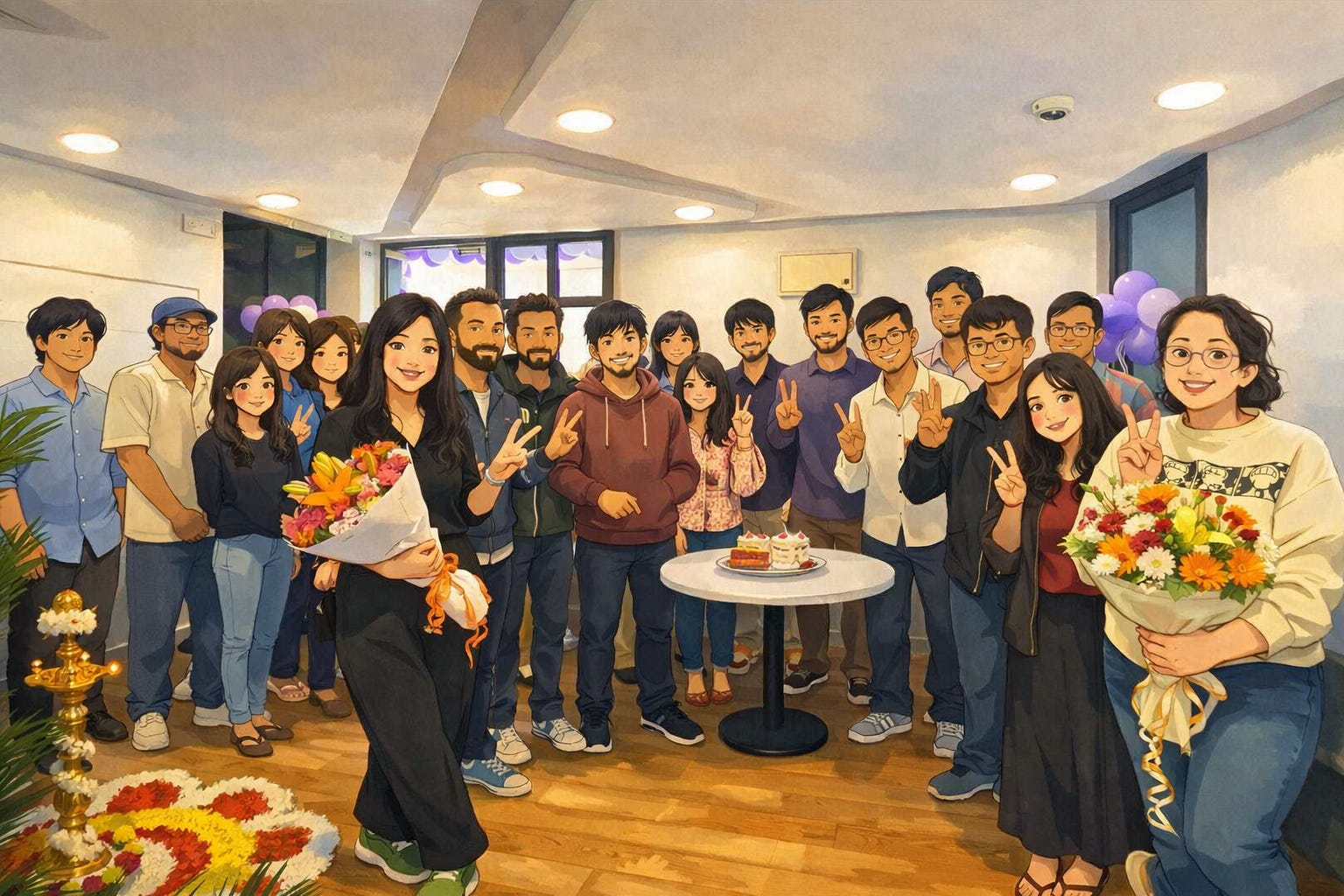
Across exit interviews and team surveys, approximately 62% of respondents explicitly highlighted the people and team culture as a core strength of working at Rocketium. In exit interviews specifically, this number rises to nearly 84%, making 'people' the single most consistently praised aspect of the company.
That consistency has been both humbling and instructive. 🤝
🦄 Owning real work, with all its messy edges
Another theme that came up again and again was learning, the kind that comes from being thrown into real problems, being trusted to figure things out, and owning outcomes that actually matter.
People love this part of working at Rocketium. It’s also the part that can feel overwhelming sometimes. High ownership means fewer handrails. Fast learning means ambiguity. And while that’s exactly what many people come here for, it’s also where the mess shows up.
✅ The opportunity to try new things
✅ Learning faster than elsewhere
✅ Seeing direct business impact
When asked what would make people pause before leaving for a higher-paying role, the answer wasn’t comfort or familiarity, it was the fear of losing ownership, impact, and the chance to build something that genuinely matters.
Here is what some of our teammates had to say -
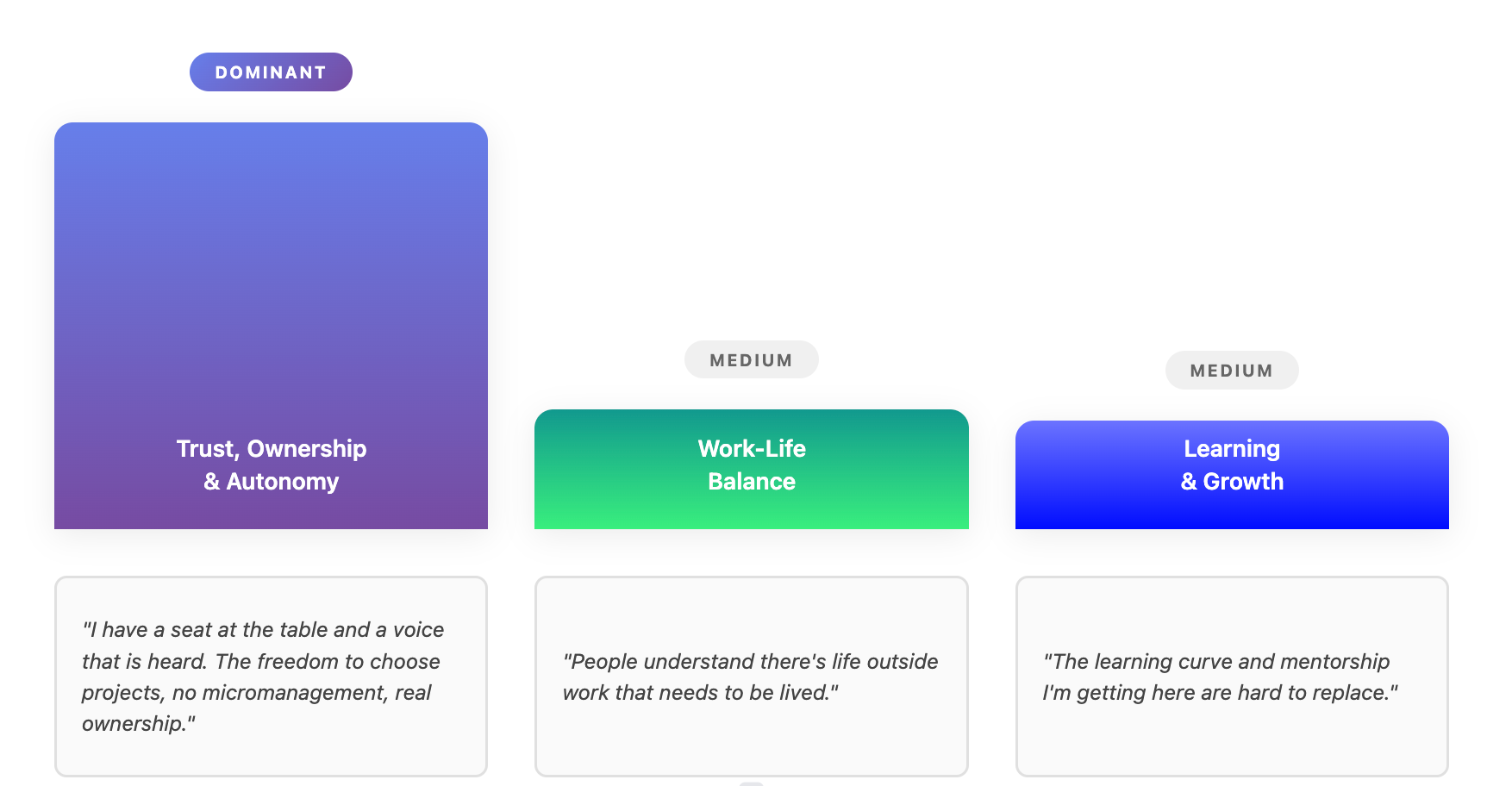
“The flexibility to work on my own time. No micro-management.”
“What would make me hesitate to leave Rocketium is the level of ownership and product influence I have here. I’m able to work closely with customers, influence product decisions, and develop team capability in a fast-moving environment. The chance to solve real, complex problems and see direct impact on both customers and the business is a strong differentiator beyond compensation.”
The opportunity to use different complementary skillsets together for bigger impact. And the sense of calm in building something good, patiently.
I think the access to choose the projects, build and work on gen ai stuff. And most important is the people and nothing else which has glued me here.
But learning and ownership also come with friction.
In our most recent survey, 45% of team members shared that while they value autonomy, the pace of working, context-switching, and making quick decisions sometimes drove them crazy. And that tension became important for us to acknowledge.
🌿 Growing confidence in leadership
Another encouraging shift over the last couple of years has been the rise in trust and confidence in leadership decisions. We heard this frequently not only in team surveys but also in exit interviews of team members moving on from Rocketium.
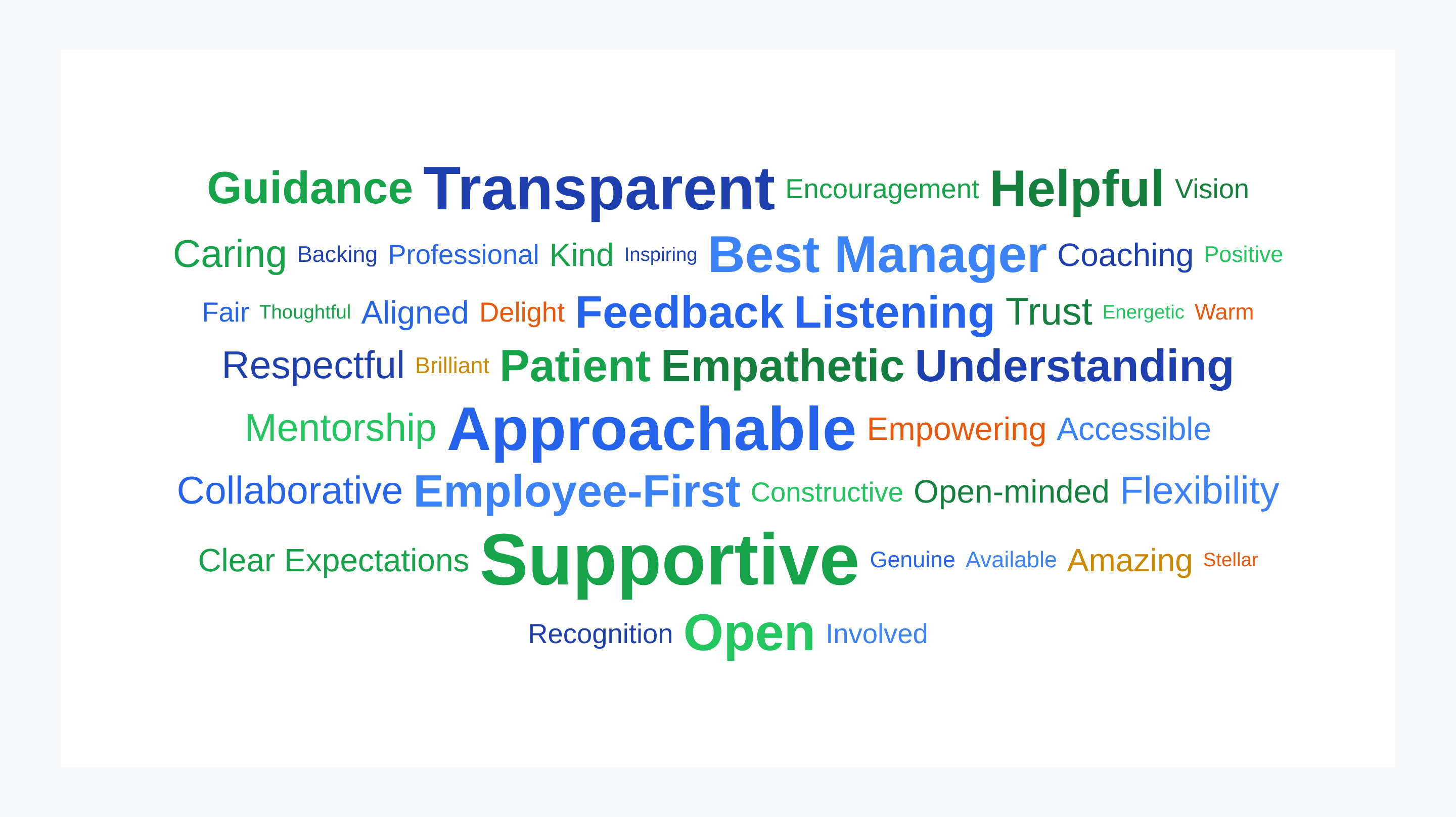
As Rocketium sharpened its focus around our AI Studio vision, more team members shared that they felt aligned with where we were headed. Transparency around wins, challenges, and trade-offs helped people feel included, not just informed.
What stood out most wasn’t the sentiment itself, but why it existed.
In our recent survey, 74% of the team members said that they trust the founders to make decisions that are in the best interest of the company.
People didn’t expect every decision to be perfect. What they valued was context, understanding the “why,” especially when decisions affected priorities or ways of working. Even when they didn’t fully agree, clarity helped maintain trust.
This distinction mattered more than any single score.
🤷🏽♀️ For a while eNPS helped, until it didn’t
If there was one metric that helped us validate our progress early on, it was eNPS.
Watching it improve over time was reassuring. It told us that advocacy was growing, that trust was strengthening, and that fewer people felt disconnected from the company. For a growing team reinventing itself, that signal mattered.
But over time, we realised something important.
eNPS told us how people felt.
It didn’t tell us what was getting in their way.
The score moved, but it didn’t help us prioritise what to fix next. And gradually, it started to feel more like a temperature check than a tool for action. 🌡️
💪🏽 From scores to context: asking harder questions
That realisation led us to try something different.
Instead of asking people how likely they were to recommend Rocketium, we asked questions that were harder, and more revealing.
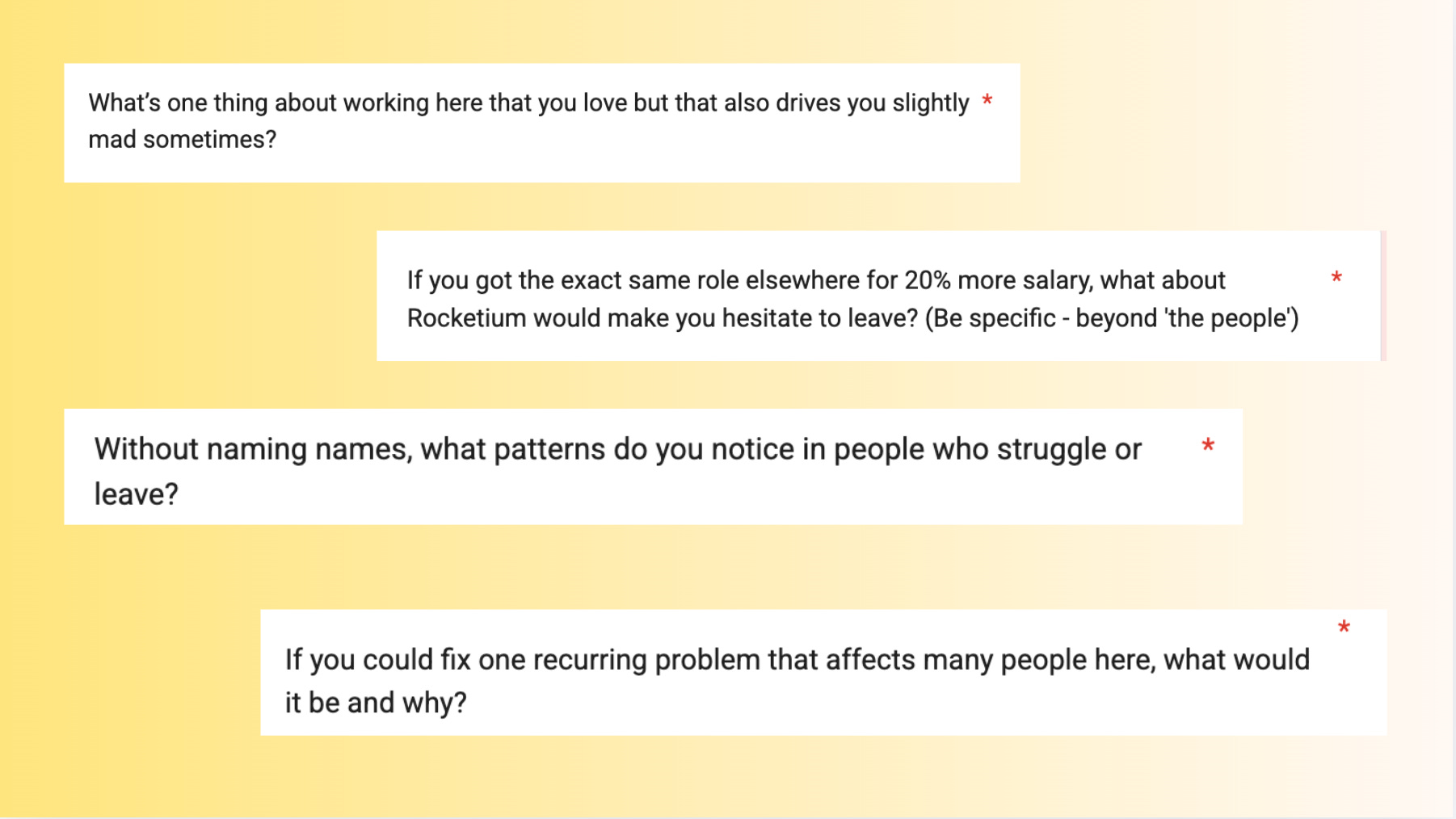
The responses were not always easy to read. But they were far more useful.
A few patterns stood out:
Many people enjoy the breadth of their roles, but feel that expectations and success markers can blur as the company scales.
When people imagined leaving, what held them back wasn’t comfort or familiarity, but impact, ownership, and the chance to build something meaningful.
Those who struggle here often expect clarity to be handed down, rather than shaped together, a cultural expectation we hadn’t always made explicit enough.
None of this showed up cleanly on a 0-10 scale. But all of it told us where to focus.
🧝🏼♀️ Listening, evolved
This journey hasn’t been about replacing one metric with another. It’s been about changing how we listen.
As the team has grown, we’ve learned that trust, pride, and advocacy can’t be fully understood through a single score. Those signals still matter but they’re only a starting point.
The most meaningful feedback often shows up in conversations, in moments of friction, and in the grey areas between what’s working and what isn’t. Learning to pay attention to those signals and to act on them has shaped how we evolve our culture and our systems.